
Volcanoes
Sites I visited to explore this topic:
Vesuvius, Herculaneum, Pompeii, Bagni della Regina Giovanna


Types of Eruptions
Stratovolcanoes are steep, conical volcanoes, built by the eruption of viscous lava flows and pyroclastic flows.
Plinian eruptions are the eruptions that have occurred in the Phlegrean Fields and Vesuvius in the past. These eruptions are very explosive and usually involve extensive ash fallout and pyroclastic flows. Ash columns can extend tens of miles into the stratosphere!
Pyroclastic flows are caused by the collapse of the large ash column. A pyroclastic flow can be defined as a very hot (>800 °C) mixture of rock fragments, gas, and ash that travels (flows) rapidly away from a volcanic vent.

Vesuvius
Vesuvius is a stratovolcano (or composite volcano) which began forming in a caldera around 17,000 years ago.
Eight major eruptions have occurred since Vesuvius’ creation. All of them have been accompanied by large pyroclastic flows/surges.
According to Professor Nave, the pyroxenes I found in the Tenorite rocks on top of Vesuvius are from the bottom of the magma chamber, which erupted to the surface in 1944.
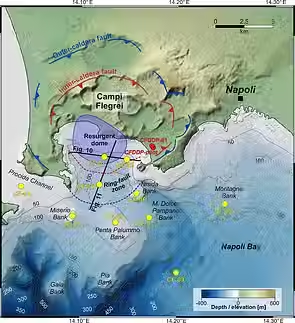
Campi Flegri (Phlegrean fields)
Campi Flegri is a volcanic caldera west of Naples.
FUN FACTS:
1. The caldera consists of many large craters.
2. Currently, around 500,000 people live within the caldera of Campi Flegri.
3. The entire caldera is not fully visible because about half of it is underwater.
There was a major volcanic event in the Phlegrean fields around 15,000 years ago which deposited the Neapolitan yellow tuff across the Sorrentine Peninsula.
